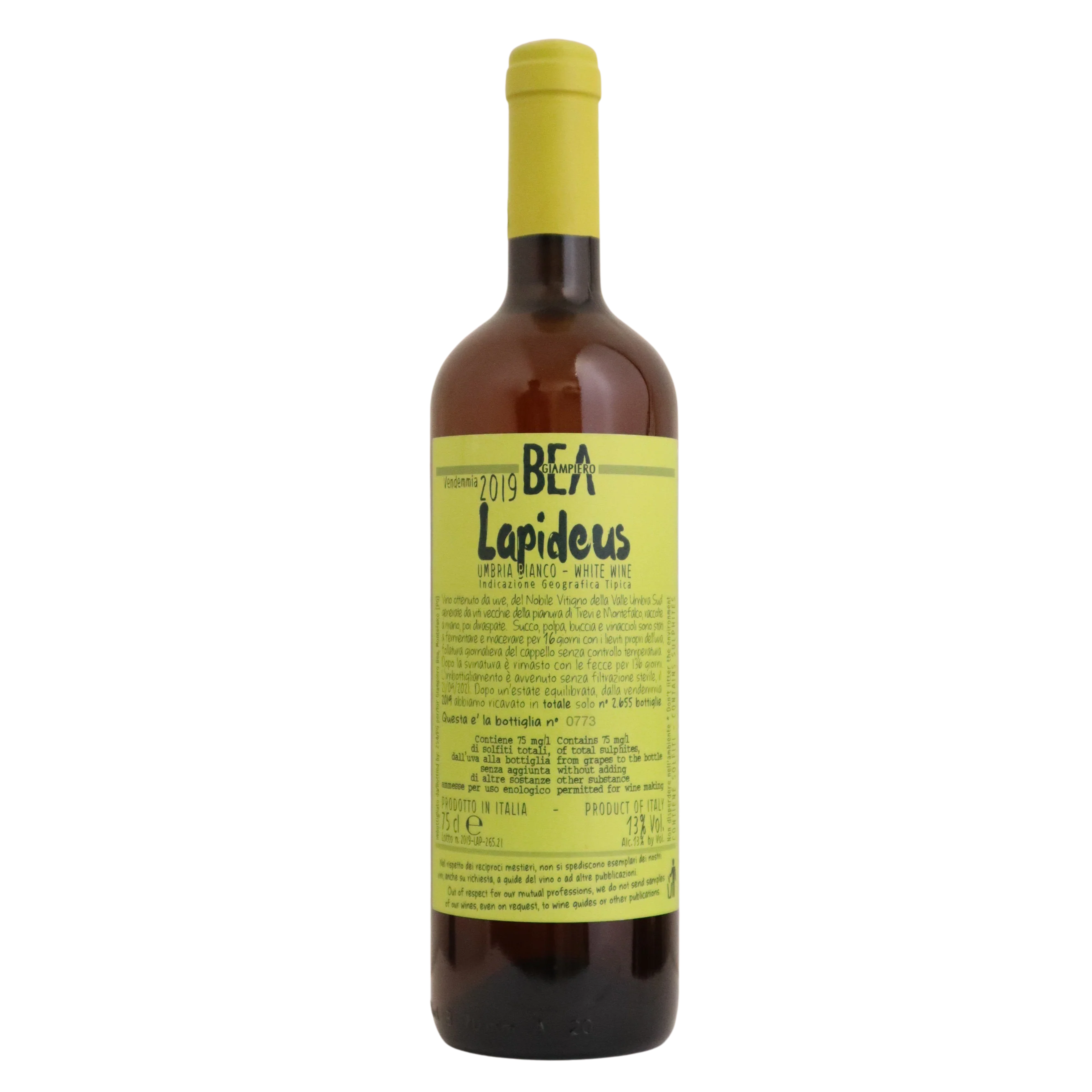
2019 Paolo Bea "Lapideus" Umbria Bianco, Umbria, Italy
ABOUT THIS WINE:
“Lapideus” spent a lengthy 35 days on it skins after pressing, followed by 210 additional days on the gross lees. It is still a wine of impressive power, especially given its modest 12% alcohol, but the fruit is more direct, pure, and foregrounded. So often the so-called “orange wines” seem to stand alone, iconoclastic creations that defy fine-tuned peer-group comparisons and revel in their singular personalities. Even the discourse that surrounds them tends to treat them more as wines of technique than wines of terroir. Thus, it is fascinating to experience the same grape variety given roughly the same treatment by the same grower, whereby the differences in the wines are largely driven by the differences in their underlying places of origin.
ABOUT THIS PRODUCER:
References in the archives of Montefalco, the beautiful hill town in Umbria, document the presence of the Bea family in this locality as early as 1500. This tiny estate is the classic Italian fattoria, producing wine, raising farm animals for trade and home consumption and working the land to produce olives, fruits and vegetables. To this day, the Bea family raises and produces much of what they consume on a daily basis. Paolo Bea, the senior member of the family, is the guiding force behind the production of this series of intense and idiosyncratic wines. He is assisted by his two sons, Giuseppe, who farms the vineyards, and Giampiero, who assists in the vinification and is responsible for all commercial aspects of the winery.
The entire property encompasses 15 hectares: 5 of which are dedicated to the vineyards, 2 to olives, and the remainder to the fruits, vegetables and grains that are grown. Sagrantino is the predominant grape, covering 60% of the vineyard surface. The remaining 40% is planted to Sangiovese and Montepulciano, with a small parcel planted to several white varieties. The vineyards are cultivated organically, all grapes are harvested manually and all wines are bottled without fining or filtration.Original: $89.99
-65%$89.99
$31.50Product Information
Product Information
Shipping & Returns
Shipping & Returns
Description
ABOUT THIS WINE:
“Lapideus” spent a lengthy 35 days on it skins after pressing, followed by 210 additional days on the gross lees. It is still a wine of impressive power, especially given its modest 12% alcohol, but the fruit is more direct, pure, and foregrounded. So often the so-called “orange wines” seem to stand alone, iconoclastic creations that defy fine-tuned peer-group comparisons and revel in their singular personalities. Even the discourse that surrounds them tends to treat them more as wines of technique than wines of terroir. Thus, it is fascinating to experience the same grape variety given roughly the same treatment by the same grower, whereby the differences in the wines are largely driven by the differences in their underlying places of origin.
ABOUT THIS PRODUCER:
References in the archives of Montefalco, the beautiful hill town in Umbria, document the presence of the Bea family in this locality as early as 1500. This tiny estate is the classic Italian fattoria, producing wine, raising farm animals for trade and home consumption and working the land to produce olives, fruits and vegetables. To this day, the Bea family raises and produces much of what they consume on a daily basis. Paolo Bea, the senior member of the family, is the guiding force behind the production of this series of intense and idiosyncratic wines. He is assisted by his two sons, Giuseppe, who farms the vineyards, and Giampiero, who assists in the vinification and is responsible for all commercial aspects of the winery.
The entire property encompasses 15 hectares: 5 of which are dedicated to the vineyards, 2 to olives, and the remainder to the fruits, vegetables and grains that are grown. Sagrantino is the predominant grape, covering 60% of the vineyard surface. The remaining 40% is planted to Sangiovese and Montepulciano, with a small parcel planted to several white varieties. The vineyards are cultivated organically, all grapes are harvested manually and all wines are bottled without fining or filtration.