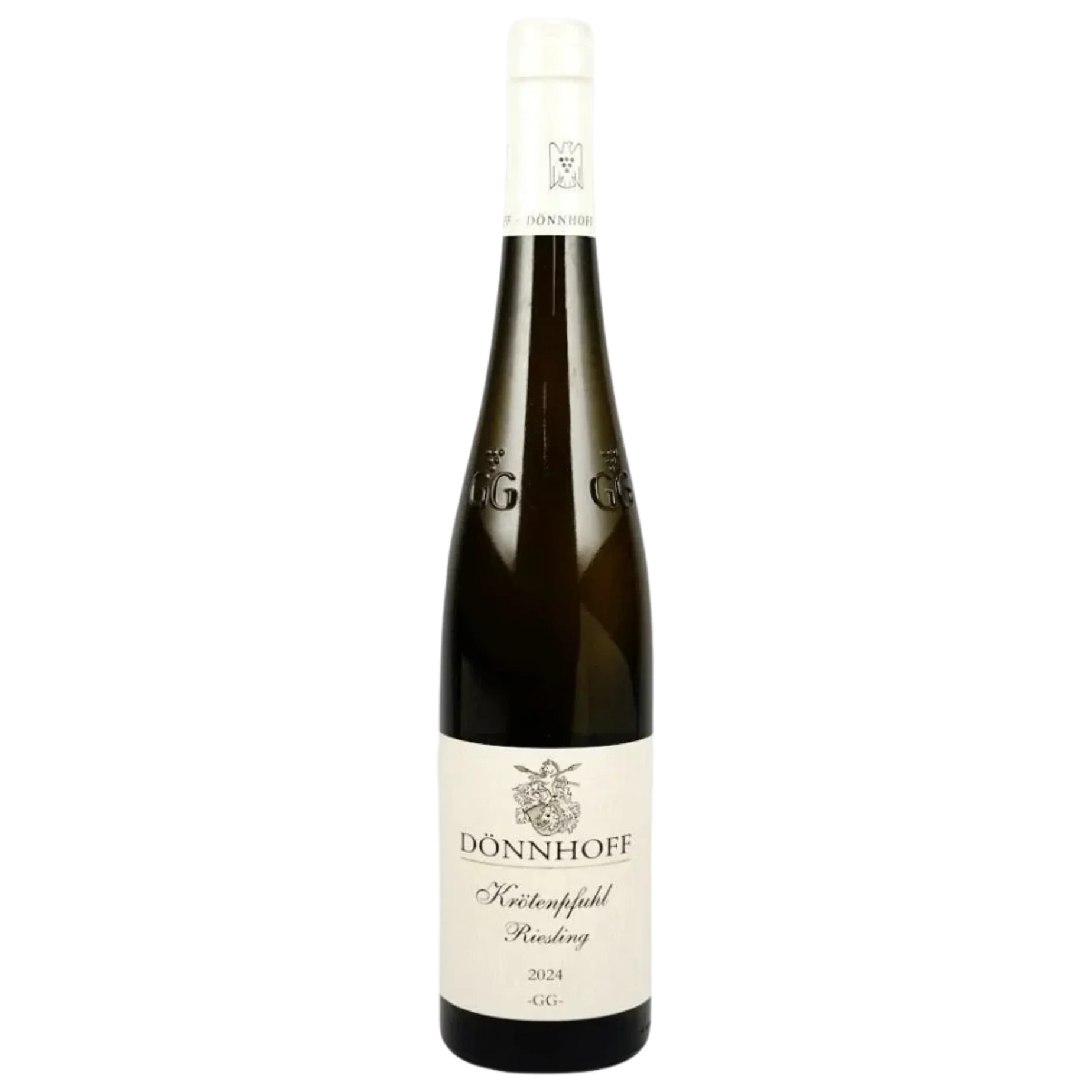
2024 Donnhoff "Krotenpfuhl" Riesling GG, Nahe, Germany
ABOUT THIS WINE
The loess loam soil of the Krötenpfuhl vineyard is notable for its high share of gravelly quartzite. Between the stony ground and its southern aspect, this neighbor to the Kahlenberg is known for warm soils and early flowering of the vines year after year. The loess loam substrate retains water well, ensuring the vines have sufficient moisture even in drought years. Vines growing in this type of pebbly soil tend to produce small berries with delicate aromas, a lively acidity and a long hang time. This small site’s advantageous microclimate ranks it among the warmest, most southerly facing and mineral-rich of the prized vineyards in Bad Kreuznach. The truly sublime Rieslings it has produced have played no small part in the growing global reputation of Nahe wines. Fermentations occur is a combination of stainless & used large oak.
ABOUT THIS PRODUCER
The Dönnhoff family first came to the Nahe region 250 years ago, establishing a traditional farm in the village of Oberhäusen an der Nahe, which included livestock and vegetable gardens in addition to some grape growing. Oberhäusen and this part of the Nahe river valley is very pastoral; it feels far away from the relative hustle and bustle of the Rheingau and wine tourism. The countryside is serene and beautiful, marked by steep hillside vineyards in the succession of villages following the river from Norheim to Niederhausen, through Oberhäusen, ending in Schlössbockelheim.
The estate was started by Helmut Dönnhoff’s grandfather, Hermann, in the 1920s. Helmut took over from his father, Hermann Jr. in 1966; at that time there were only four hectares under vine and still quite a bit of farmland, which was rented out. In 1971, the farmland was sold and Helmut turned his full attention to producing quality wine.
Original: $77.99
-65%$77.99
$27.30Product Information
Product Information
Shipping & Returns
Shipping & Returns
Description
ABOUT THIS WINE
The loess loam soil of the Krötenpfuhl vineyard is notable for its high share of gravelly quartzite. Between the stony ground and its southern aspect, this neighbor to the Kahlenberg is known for warm soils and early flowering of the vines year after year. The loess loam substrate retains water well, ensuring the vines have sufficient moisture even in drought years. Vines growing in this type of pebbly soil tend to produce small berries with delicate aromas, a lively acidity and a long hang time. This small site’s advantageous microclimate ranks it among the warmest, most southerly facing and mineral-rich of the prized vineyards in Bad Kreuznach. The truly sublime Rieslings it has produced have played no small part in the growing global reputation of Nahe wines. Fermentations occur is a combination of stainless & used large oak.
ABOUT THIS PRODUCER
The Dönnhoff family first came to the Nahe region 250 years ago, establishing a traditional farm in the village of Oberhäusen an der Nahe, which included livestock and vegetable gardens in addition to some grape growing. Oberhäusen and this part of the Nahe river valley is very pastoral; it feels far away from the relative hustle and bustle of the Rheingau and wine tourism. The countryside is serene and beautiful, marked by steep hillside vineyards in the succession of villages following the river from Norheim to Niederhausen, through Oberhäusen, ending in Schlössbockelheim.
The estate was started by Helmut Dönnhoff’s grandfather, Hermann, in the 1920s. Helmut took over from his father, Hermann Jr. in 1966; at that time there were only four hectares under vine and still quite a bit of farmland, which was rented out. In 1971, the farmland was sold and Helmut turned his full attention to producing quality wine.